
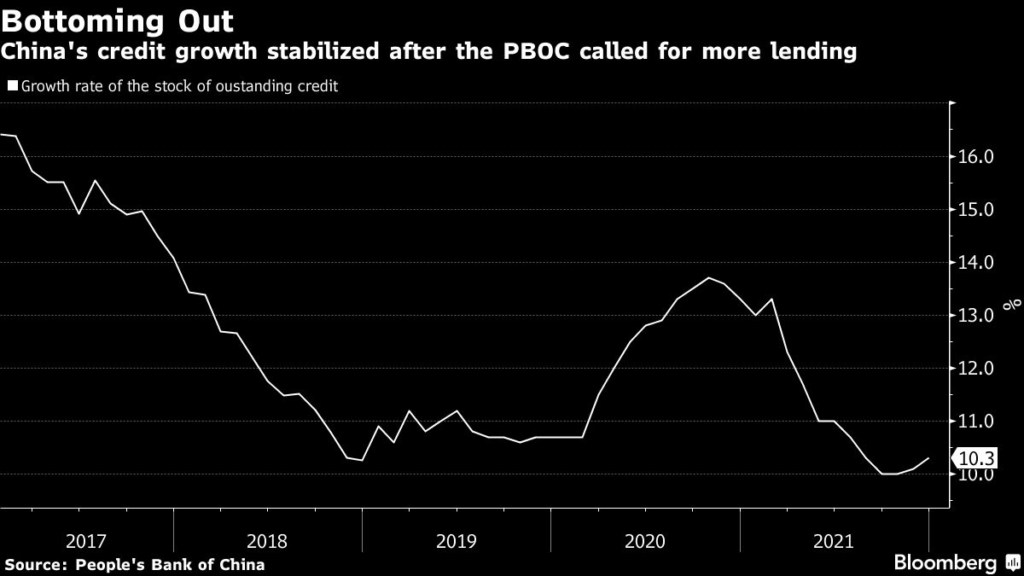
(Bloomberg) — China’s credit expansion stabilized in December, after the central bank called for stable loan growth and an increase in lending to the struggling property industry.
- Aggregate financing was 2.37 trillion yuan ($372 billion) last month, the People’s Bank of China said Wednesday, down from 2.61 trillion yuan in November and compared with 1.6 trillion yuan in December 2020. The median estimate in a Bloomberg survey of economists was 2.4 trillion yuan
- Financial institutions offered 1.13 trillion of new loans in the month, down from 1.27 trillion yuan in November. Economists had projected 1.25 trillion yuan
- The stock of outstanding credit grew 10.3% to 314.13 trillion yuan, faster than the 10.1% expansion in November.
There are growing expectations that the central bank will guide credit growth to accelerate in early 2022, after its pace of expansion slowed significantly from February 2021. The government has also vowed to accelerate investment, pushing faster sales of infrastructure bonds to pay for spending.
As the property market downturn and weak consumer demand continued to weigh on growth, the PBOC is expected to loosen its credit policy to boost the economy, on top of continuing to encourage lending to small businesses and green projects.
Annual new yuan loans reached 19.95 trillion yuan in 2021, higher than the 19.6 trillion yuan in 2020. The PBOC focused on containing surging debt in the economy last year and kept tight restrictions on property developers’ financing, after stimulus during the pandemic pushed debt levels to a record in early 2021.
The PBOC vowed to make overall credit expansion more stable in a meeting with major policy and commercial banks last month, and financial regulators called on banks to increase lending to the real-estate sector in the first quarter to ease the industry’s liquidity crisis, after property development loans declined for two straight quarters through September. The PBOC also guided banks to lower the one-year benchmark lending rate by 5 basis points and cut banks’ required reserves.
The increase in government bond financing should have supported a pickup in overall financing growth, according to a note by Standard Chartered Plc economists last week. Mortgage and real estate loan growth may have stabilized on marginal policy loosening, while corporate loan growth likely slowed partly due to a high base, they said.
Other details
- Household mid and long-term loans, a proxy for mortgages, increased 356 billion yuan, down from the 582.1 billion yuan added in November
- Broad M2 money supply grew 9%, up from 8.5% in November
- Shadow banking — comprising entrusted loans, trust loans and undiscounted banker’s acceptances — fell 641 billion yuan, down for an 11th straight month
(Updates from seventh paragraph.)
More stories like this are available on bloomberg.com
©2022 Bloomberg L.P.