
(Bloomberg) — Asian stocks looked set to follow a bounce in the U.S. after Federal Reserve Chair Jerome Powell reassured investors the central bank will tackle inflation to extend the economic expansion.
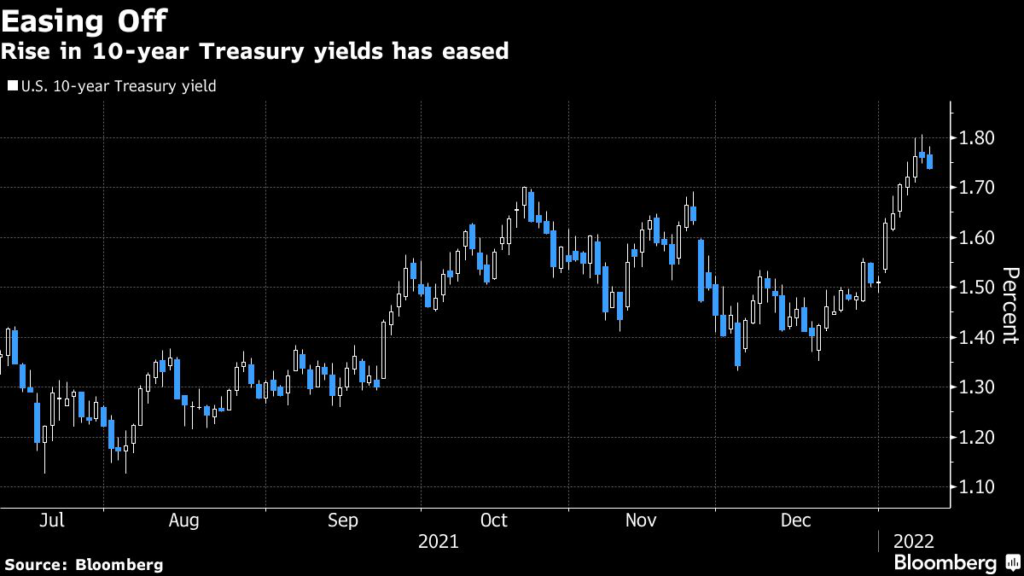
Shares in Australia advanced. Futures rose in Japan and Hong Kong. U.S. contracts fluctuated after the S&P 500 halted a five-day slide and the Nasdaq 100 outperformed. Treasuries found support after a solid three-year note sale. The yield on the 10-year note dipped, while the curve flattened. The dollar declined and commodity-linked currencies like the Australian and Canadian dollars climbed alongside a jump in oil prices.
Powell told the Senate Banking Committee that officials won’t hesitate to act if needed to contain price pressures. He also said the Fed will probably start shrinking its balance sheet this year. He noted the runoff would be quicker than the last time the central bank shrank its balance sheet because the economy was in a much stronger position.
The next focus for traders is Wednesday’s U.S. consumer price index print that is expected to show unrelenting price pressure. Markets have been buffeted by volatility at the start of the year on the prospect of faster interest rate increases to deal with the surge in inflation.
“The market is grappling with a broad-based rotation and the potential for a hastened pace of rate hikes, which is leading to volatility,” Greg Marcus, a managing director at UBS Private Wealth Management, said in a note. “Regardless of the volatility seen in markets so far this year, corporate fundamentals are strong and we are expecting double-digit earnings growth this year, which should bode well for stock prices in 2022.”
Strategists from Goldman Sachs Group Inc. to UBS Global Wealth Management seem unperturbed by equities’ rocky start to 2022, reiterating their bullish calls on bets that equities can weather higher rates and rising bond yields.
Meanwhile, U.S.-listed Chinese stocks surged on measures to stabilize trade as economic risks mount. The Nasdaq Golden Dragon China Index jumped as much as 4.7%. Goldman Sachs Group Inc. cut its forecast for China’s growth this year as the nation struggles to contain the spread of omicron.
Elsewhere, Bitcoin traded above $42,500 after its roughest start to a year and ominous technical indicators.
Here are some key events this week:
- EIA crude oil inventory report on Wednesday.
- China PPI, CPI on Wednesday.
- U.S. CPI, Fed Beige Book on Wednesday.
- U.S. initial jobless claims, PPI on Thursday.
- U.S. Senate Banking Committee hearing for Lael Brainard, nominated as Fed vice-chair on Thursday.
- Richmond Fed President Thomas Barkin, Philadelphia Fed President Patrick Harker,
- Chicago Fed President Charles Evans speak on Thursday.
- Bank of Korea policy decision and briefing on Friday.
- Wells Fargo, Citigroup, JPMorgan due to report earnings on Friday.
- U.S. business inventories, industrial production, University of Michigan consumer sentiment, retail sales on Friday.
- New York Fed President John Williams speaks Friday.
For more market analysis, read our MLIV blog.
Some of the main moves in markets:
Stocks
- S&P 500 futures were little changed as of 8:03 a.m. in Tokyo. The S&P 500 rose 0.9%
- Nasdaq 100 futures were little changed. The Nasdaq 100 rose 1.5%
- Nikkei 225 futures rose 1.1%
- Australia’s S&P/ASX 200 Index gained 0.3%
- Hang Seng Index futures added 1.2% earlier
Currencies
- The Japanese yen was at 115.32 per dollar
- The offshore yuan traded at 6.3774 per dollar
- The Bloomberg Dollar Spot Index fell 0.3%
- The euro was at $1.1368
Bonds
- The yield on 10-year Treasuries declined more than one basis point to 1.74%
- Australia’s 10-year bond yield fell two basis points to 1.88%
Commodities
- West Texas Intermediate crude was at $81.24 a barrel
- Gold was at $1,820.71 an ounce
More stories like this are available on bloomberg.com
©2022 Bloomberg L.P.