
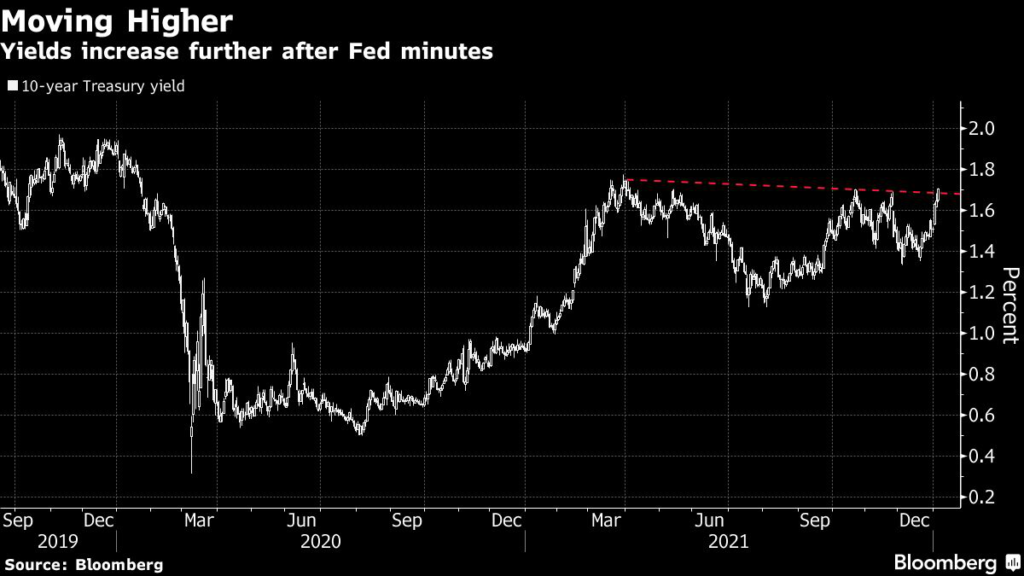
(Bloomberg) — The Treasury selloff that started the year is deepening as investors scramble to price in the risk that the Federal Reserve raises interest rates faster than currently anticipated to contain inflation.
Yields on U.S. 10-year notes climbed to 1.73% on Thursday, just shy of the 2021 high of 1.77% set in April. The yield has spiked up 22 basis points this week, set for the steepest increase since June 2020. The jump came as bonds and equities sold off across Asia, extending moves from Wednesday when hawkish Fed minutes flagged a future in which central bank stimulus is likely to offer less support for asset prices.
“The Fed set the cat among the pigeons as the minutes made it clear an acceleration in Fed tapering will give them more options,” said Prashant Newnaha, an Asia-Pacific rates strategist at TD Securities in Singapore.
Federal Open Market Committee members also discussed starting to shrink the central bank’s swollen balance sheet soon after their first hike, the minutes showed. That would be a more aggressive approach than during the previous rate-hike cycle in the 2010s, when the Fed waited almost two years after liftoff to begin trimming the stockpile of assets built up as it injected cash into the economy.
“These minutes are very hawkish, and it shows an FOMC that wants to lean against the market big time,” said George Goncalves, head of U.S. Macro strategy at MUFG. “The bond market still views policy tightening being primarily conducted through the front end,” which may mean that short-dated yields will lead the way higher until plans for shrinking the balance sheet come into focus, he said.
Asian bond markets followed Treasuries lower. Japan’s benchmark 10-year yield climbed to the highest since April 2021, while similar yields in Australia and New Zealand rose to the most since November.
U.S. government bonds lost about 1% on Monday and Tuesday alone, adding to the 2.3% decline in 2021 that marked the worst year since 2013, according to data compiled by Bloomberg.
The already bearish mood was reinforced by the release of the minutes from the Fed’s December meeting, when it decided to conclude its monthly bond purchases by March, paving the way for raising its overnight benchmark rate. The minutes revealed that, on average, policy makers expect to raise rates three times this year.
The minutes also sharpened investors’ focus on the Fed’s balance-sheet decision as policy makers debated how the reduction of the central bank’s assets will intertwine with rates policy and how that may impact the shape of the curve. Fed Governor Christopher Waller said last month an early start to shrinking the balance sheet means “you don’t have to raise rates quite as much.”
The Fed’s balance sheet has doubled in size to more than $8 trillion since March 2020, when the central bank resumed buying Treasuries and mortgage-backed securities, first to stabilize the market and then to provide additional support to the economy as it held the policy rate at the zero bound.
“The FOMC minutes indicate Fed wants rate hikes sooner or at a faster pace, earlier balance-sheet runoff, and desire for steeper yield curve,” said Ray Sharma-Ong, investment director for multi-asset solutions at abrdn in Singapore.
(A previous version of this story corrected the level reached by 10-year yields.)
More stories like this are available on bloomberg.com
©2022 Bloomberg L.P.