
(Bloomberg) — The rout in U.S. technology stocks continued Wednesday as rising Treasury yields fueled greater concern about growth and profitability.
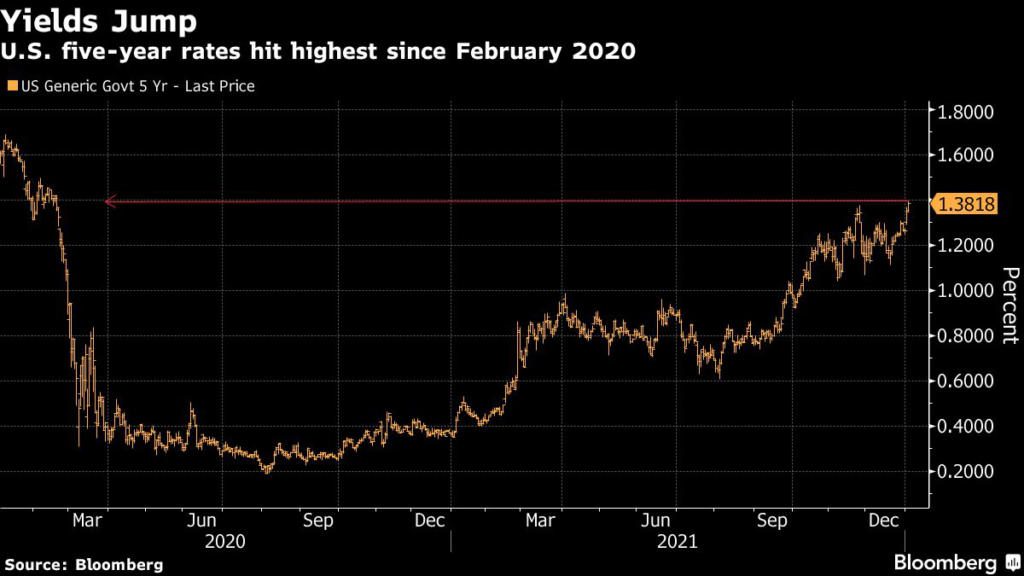
The yield on the U.S. 10-year hovered near 1.65% after a private jobs report indicated more Americans are returning to the labor force, giving traders greater conviction the Federal Reserve will raise rates three times this year.
The S&P 500 fell while stocks in Europe and Asia were also weaker. The tech selloff extended into Asia trading, with a gauge Chinese names listed in Hong Kong at a six-year low.
Markets have turned their attention to tightening central bank policies in addition to the persistent threat of the omicron variant to global growth. Hong Kong, reimposed social curbs and halted flights from eight countries. Meanwhile, U.S. school closings are accelerating.
“Earlier we thought that rate hikes wouldn’t be on the table until mid-2022 but the Fed seems to have worked up a consensus to taper faster and hike sooner rather than later,” Steve Englander, head of global G-10 FX research at Standard Chartered, said in a note. “But we don’t think inflation dynamics will support continued hiking. We suspect the biggest driver of asset markets will be when inflation and Covid fears begin to ebb.”
Data from the ADP Research Institute showed Wednesday U.S. companies in December added the most jobs in seven months, indicating that more Americans are returning to the labor force. The report precedes Friday’s monthly jobs report from the Labor Department, which is currently forecast to show that the U.S. added 384,000 private payrolls in December.
However, other data have shown that more than 10 million jobs can’t find people to fill them as the process known as the Great Resignation deepens. That leaves Fed with little power to influence the employment numbers increasingly dictated by social reasons.
The Fed’s other mandate, price stability, is seen coming to the fore from a policy perspective. Treasury yields are firmer this week amid increasing conviction the Fed will raise rates at least three times beginning in May to counter price pressures.
“Building evidence that omicron has lower severity than previous variants is helping reduce investor concerns about the economic impact of the current wave, allowing them to shift focus to inflation and the Fed policy pivot,” wrote Dennis DeBusschere, founder of 22V Research.
In Hong Kong, the Hang Seng China Enterpries Index tumbled 2% to the lowest level since February 2016. Tencent Holdings Ltd. came under pressure as it pared investment in the technology sector amid Beijing’s regulatory crackdown.
Meanwhile, North Korea appeared to have launched its first ballistic missile in about two months, just days after leader Kim Jong Un indicated that returning to stalled nuclear talks with the U.S. was a low priority for him in the coming year.
What to watch this week:
- FOMC meeting minutes scheduled for release Wednesday
- Fed’s Bullard discusses the U.S. economy and monetary policy in an event on Thursday
- Fed’s Daly discusses monetary policy on a panel Friday
- ECB’s Schnabel speaks on a panel Saturday
For more market analysis, read our MLIV blog.
Some of the main moves in markets:
Stocks
- The S&P 500 fell 0.2% as of 9:46 a.m. New York time
- The Nasdaq 100 fell 0.5%
- The Dow Jones Industrial Average was little changed
- The Stoxx Europe 600 was little changed
- The MSCI World index fell 0.1%
Currencies
- The Bloomberg Dollar Spot Index fell 0.3%
- The euro rose 0.4% to $1.1335
- The British pound rose 0.1% to $1.3550
- The Japanese yen rose 0.4% to 115.73 per dollar
Bonds
- The yield on 10-year Treasuries was little changed at 1.65%
- Germany’s 10-year yield advanced four basis points to -0.08%
- Britain’s 10-year yield declined one basis point to 1.07%
Commodities
- West Texas Intermediate crude rose 1.6% to $78.20 a barrel
- Gold futures rose 0.8% to $1,828.60 an ounce
More stories like this are available on bloomberg.com
©2022 Bloomberg L.P.