
(Bloomberg) — European stocks opened steady and U.S. index futures trimmed losses as investors weighed the outlook for global inflation against expanded Covid-related curbs. A technology rout that battered Asia had a muted impact on Europe.
Contracts on the Nasdaq 100 Index traded 0.3% lower after falling as much as 0.6%, easing some of the caution over the impact higher yields on equity valuations. Europe’s Stoxx 600 gauge was little changed near a record high. Treasuries were steady and the dollar weakened.
Markets got another reminder of the continuing threat to global growth from the pandemic as Hong Kong reimposed social curbs and halted flights from eight countries. Meanwhile, a selloff in technology stocks extended to Asia, sending a gauge of Chinese names listed in Hong Kong toward a six-year low. Traders are now caught in a quandary over deepening fears on global growth combined with a faster tightening by the Federal Reserve.
“Earlier we thought that rate hikes wouldn’t be on the table until mid-2022 but the Fed seems to have worked up a consensus to taper faster and hike sooner rather than later,” Steve Englander, head of global G-10 FX research at Standard Chartered, said in a note. “But we don’t think inflation dynamics will support continued hiking. We suspect the biggest driver of asset markets will be when inflation and Covid fears begin to ebb.”
Data Tuesday showed mixed signs on U.S. inflation. Prices paid by manufacturers in December came in sharply lower than expected. However, figures showing a faster U.S. job quit rate added to concerns over wage inflation.
With 4.5 million Americans leaving their jobs in November, compared with 10.6 million available positions, the odds increased the Fed will struggle to influence the employment numbers increasingly dictated by social reasons. The data came before Friday’s monthly report from the Labor Department, currently forecast to show 420,000 job additions in December.
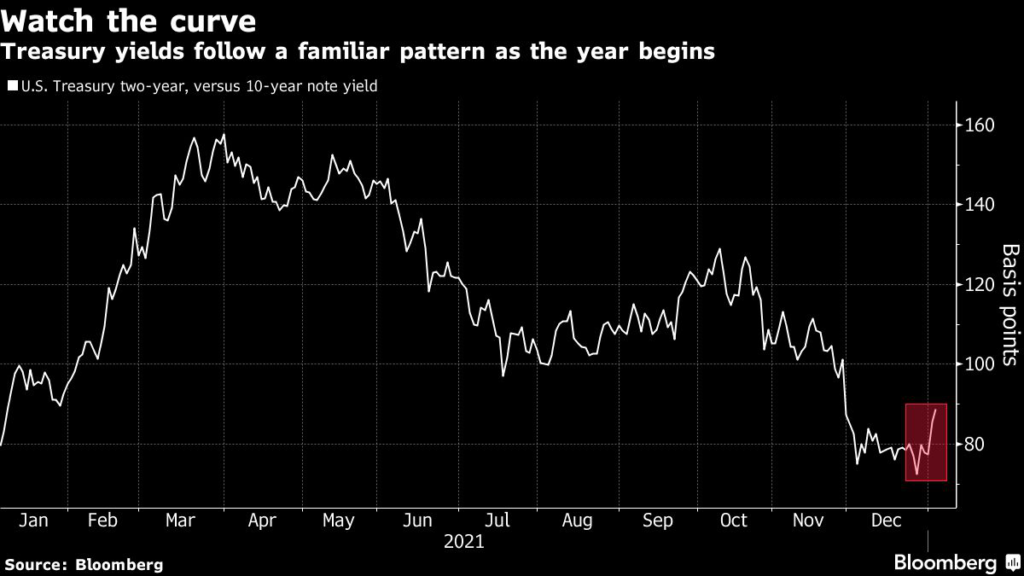
Treasuries were steady Wednesday after yields rose amid increasing conviction the Fed will raise rates at least three times beginning in May to counter price pressures.
Europe’s equity benchmark held near a record high as carmakers and energy companies posted some of the biggest gains.
In Hong Kong, the Hang Seng China Enterpries Index tumbled 2% to the lowest level since February 2016. Tencent Holdings Ltd. came under pressure as it pared investment in the technology sector amid Beijing’s regulatory crackdown.
Meanwhile, North Korea appeared to have launched its first ballistic missile in about two months, just days after leader Kim Jong Un indicated that returning to stalled nuclear talks with the U.S. was a low priority for him in the coming year.
Crude oil futures slipped. OPEC and its allies agreed to revive more halted production as the outlook for global oil markets improved, with demand largely withstanding the new coronavirus variant.
What to watch this week:
- FOMC meeting minutes scheduled for release Wednesday
- Fed’s Bullard discusses the U.S. economy and monetary policy in an event on Thursday
- Fed’s Daly discusses monetary policy on a panel Friday
- ECB’s Schnabel speaks on a panel Saturday
For more market analysis, read our MLIV blog.
Some of the main moves in markets:
Stocks
- The Stoxx Europe 600 was little changed as of 8:43 a.m. London time
- Futures on the S&P 500 fell 0.1%
- Futures on the Nasdaq 100 fell 0.3%
- Futures on the Dow Jones Industrial Average were little changed
- The MSCI Asia Pacific Index fell 0.4%
- The MSCI Emerging Markets Index fell 0.9%
Currencies
- The Bloomberg Dollar Spot Index fell 0.1%
- The euro rose 0.1% to $1.1302
- The Japanese yen rose 0.2% to 115.94 per dollar
- The offshore yuan was little changed at 6.3717 per dollar
- The British pound rose 0.1% to $1.3547
Bonds
- The yield on 10-year Treasuries was little changed at 1.64%
- Germany’s 10-year yield advanced three basis points to -0.09%
- Britain’s 10-year yield declined one basis point to 1.07%
Commodities
- Brent crude fell 0.4% to $79.69 a barrel
- Spot gold rose 0.2% to $1,817.37 an ounce
More stories like this are available on bloomberg.com
©2022 Bloomberg L.P.