
(Bloomberg) —
There’s trouble brewing for the pound after U.K. Prime Minister Boris Johnson warned of a coronavirus emergency.
Institutional investors have taken their biggest bets against the currency in more than five years, according to latest data from the Commodity Futures Trading Commission.
Sterling fell 0.3% to $1.3234 as of 8:01 a.m. in London, approaching a one-year low after Johnson said a “tidal wave” of omicron infections threatens to overwhelm the country’s health system. The message added to fears about the country’s sputtering recovery which have caused traders to pare back bets on a Bank of England interest-rate hike this Thursday — which just weeks ago looked like a done deal.
“We’ve come full turn on the pound — certainly from having a fairly bullish view at the start of the year,” Viraj Patel, global macro strategist at Vanda Research Ltd., said in an interview with Bloomberg TV. Sterling reaching $1.30 is a “risk” in the next couple of months, he said, recommending divergence trades such as short sterling against long Australian dollar.
Mizuho Bank Ltd., MUFG and Canadian Imperial Bank of Commerce see a deeper decline toward $1.30 or beyond in the coming weeks, while sentiment in the options market is close to the most bearish in 12 months.
Read More: Boris Johnson Faces Battles on All Fronts as Controversies Mount
Unlike their peers in other major currency markets, pound traders are having to recalibrate their expectations for central bank policy. Parts of Europe face far stricter lockdowns, yet there is little question the European Central Bank will remain dovish. And in the U.S, hawkish expectations for the Federal Reserve continue to build, lifting the dollar.
“It is quite likely that like us some investors believe that the market has priced in too many rate hikes into the U.K. curve for next year,” said Jane Foley, head of foreign exchange strategy at Rabobank. “If this is priced out the pound is set to fall.”
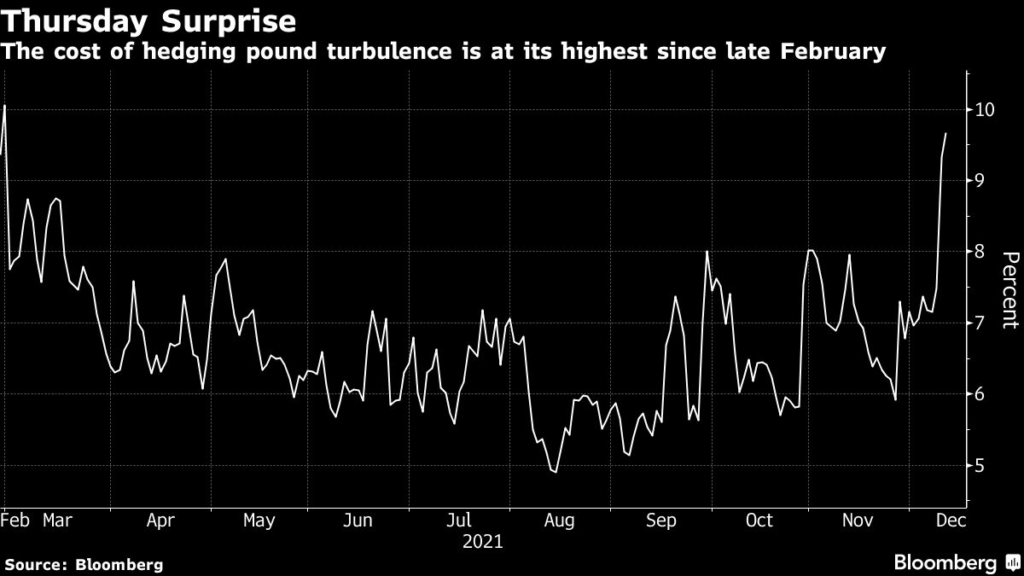
Nerves are fraying. The cost of hedging swings in the pound going into the BOE decision is at its highest in more than nine months, with money market traders betting an increase in borrowing costs won’t come until February.
Strategists are paring back their targets for the pound, though they may still be playing catch-up with the news cycle. They’ve slashed their forecasts by nearly 4% to $1.35 for the end of March, compared with $1.40 three months ago, according to the median forecast in a Bloomberg survey.
It’s enough for Citigroup Inc. to view the pound as the least-preferred Group-of-10 currency against the dollar with a fair value of $1.29, more than 2% weaker from current levels, according to Ebrahim Rahbari, the bank’s global head of foreign exchange analysis.
Not everyone is so bearish. While Barclays Plc expects the BOE will start raising rates in February, passing on Thursday’s meeting is not going to cause “much of a disappointment for financial markets,” said Eimear Daly, an analyst at the firm.
“We think the pound is going to benefit from inflation peaking in the first half of next year,” Daly said. “And growth has actually been relatively resilient in the U.K.”
Downing Street Chaos
Still, a further rethink about the BOE’s ability to tighten next year could be in store. And investors are beginning to take note of the political turmoil engulfing the prime minister after his staff were accused of breaking lockdown rules with a Christmas party last year.
(Adds CFTC data in second paragraph, comment from Vanda Research in fourth.)
More stories like this are available on bloomberg.com
©2021 Bloomberg L.P.