
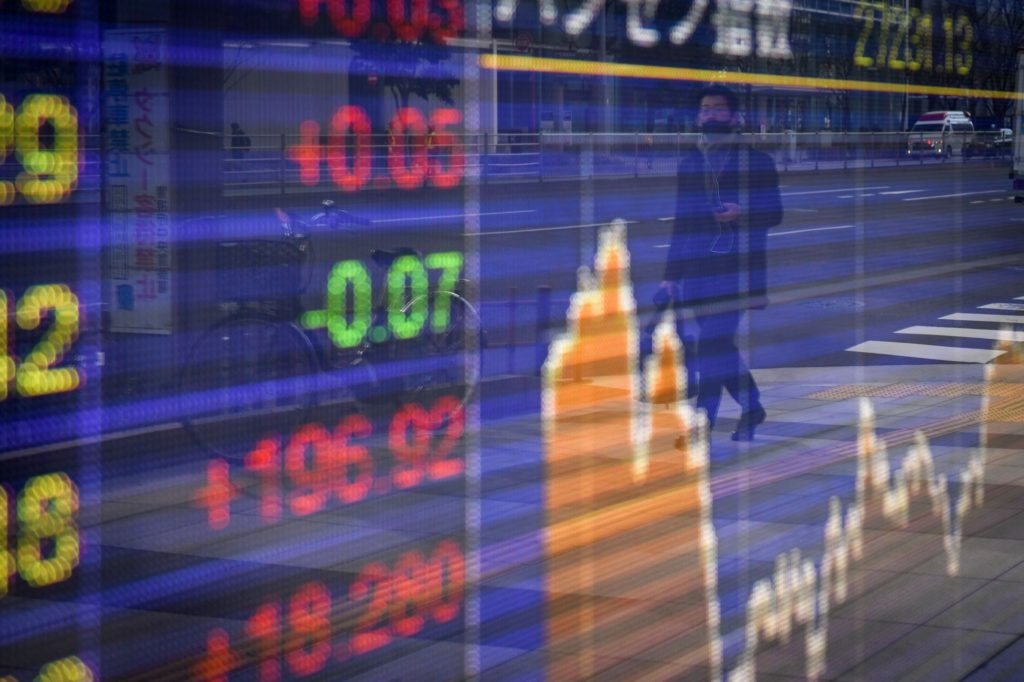
(Bloomberg) — Asian stocks followed their U.S. peers lower as traders weighed the economic threat of virus restrictions against optimism about the efficacy of vaccines. Treasuries gained.
Equity markets saw modest losses across the region. U.S. futures steadied after benchmarks ended a three-day rally on Thursday amid losses in the consumer discretionary and real estate sectors. Treasuries inched higher, having pared back an overnight rally after a lackluster sale of 30-year bonds. Oil fell toward $70 per barrel and Bitcoin pared losses. The dollar held overnight gains.
Chinese markets are in focus after China Evergrande Group and Kaisa Group Holdings Ltd. officially defaulted on their dollar debt. Evergrande shares fell over 1% at the start of trading. Kaisa’s shares, which are traded in Hong Kong, were suspended.
China’s central bank set a weaker reference rate for the yuan than expected, spurring fresh declines for the currency in offshore trading after policy makers yesterday raised their foreign currency reserve requirement ratio for a second time this year.
Investors are mulling the cost to contain the omicron strain amid mounting concern it will crimp the economic rebound. A study has found omicron is 4.2 times more transmissible than the delta variant in its early stages.
“Ultimately the issue from a health perspective is that even if Omicron does prove to be less severe — which the initial indications so far have pointed to — a rise in transmissibility could offset that,” said a team of Deutsche Bank strategists including Jim Reid. That could mean that more people are in the hospital, “even if a lower proportion of them are severely affected.”
Meanwhile, the global equity rally faces further potential road bumps ahead from U.S. consumer inflation numbers on Friday and a Federal Reserve meeting next week that may provide clues on the pace of tapering and interest rate increases.
“Various FOMC participants, including Chair Powell, have signaled a hawkish shift in their policy stance, catalyzed by increasing discomfort with elevated inflation against a backdrop of robust growth and ongoing strengthening in labor markets conditions,” said Morgan Stanley economists and strategists including Ellen Zentner, in a note Thursday. “We revise our Fed call and now expect the FOMC to begin raising rates in Sept. 2022 — two quarters earlier than our prior forecast.”
Elsewhere, the dollar was flat. It rose Thursday after a report showed applications for U.S. state unemployment benefits declined to the lowest level since 1969. However, economists flagged difficulties in seasonal adjustments to arrive at that figure.
Bloomberg’s Markets Live team is running a survey on asset views for 2022. It’s anonymous, takes about 2 minutes, and the results will be shared in the latter part of December. To participate, click here.
Here are some key events to watch this week:
- U.S. CPI Friday
For more market analysis, read our MLIV blog.
Some of the main moves in markets as of 10:43 a.m. in Tokyo:
Stocks
- S&P 500 futures gained 0.1%. The index fell 0.7% Thursday.
- Nasdaq 100 futures advanced 0.2%. The benchmark fell 1.5% Thursday.
- Topix fell 0.4%
- Hang Seng dropped 0.4%.
- Shanghai Composite declined 0.4%.
- The S&P/ASX 200 dropped 0.5%.
- Kospi declined 0.6%.
Currencies
- The Bloomberg Dollar Spot Index was flat.
- The euro was little-changed at $1.1295
- The Japanese yen rose 0.1% to 113.35 per dollar
- The offshore yuan was at 6.3778.
Bonds
- The yield on 10-year Treasuries fell about one basis points to 1.49%.
- The yield on Australia’s 10-year bonds dropped about five basis points to 1.63%.
Commodities
- West Texas Intermediate crude fell 0.2% to $70.78 a barrel.
- Gold was rose 0.2% to $1,778.83 an ounce.
More stories like this are available on bloomberg.com
©2021 Bloomberg L.P.